

Building pathways to economic mobility for Latino families
in San Francisco’s Mission District and beyond
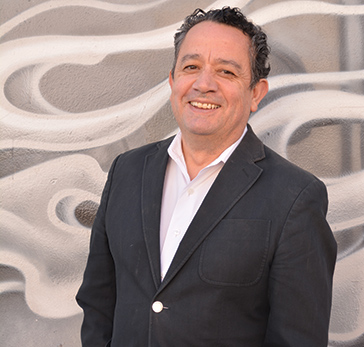
Letter from the CEO
For over fifty years, MEDA has centered our work on a simple yet profound goal: ensuring Mission District families have the power to shape their futures. We’ve been honored to support thousands of residents in their pursuit of economic mobility—because everyone deserves the chance to move forward.
Guided by our values of equity, audacity, ecosystem, impact, and togetherness, MEDA has grown from a neighborhood nonprofit into a national model for community-based economic development. To support clients, we’ve delivered over 2,500 affordable homes, deployed millions through our CDFI to fuel small business growth, and helped thousands of families build financial health.
San Francisco stands at a crossroads. With one in seven children living in poverty and widening income inequality straining working families amid soaring housing costs, the need for action has never been clearer. From 2025-2030, MEDA will focus on four strategic areas to realize a San Francisco where everyone has real opportunities for economic mobility—starting in the Mission District.
MEDA’s vision is bold and achievable: a future where Latino and immigrant families can choose where to live, build wealth, and lead social change. Join us in making upward economic mobility not a privilege for the few, but a promise we deliver together for all families.
Luis Granados
CEO
Advancing economic mobility for Latino communities since 1973
Rooted in San Francisco’s Mission District, MEDA has evolved alongside our community, responding to the aspirations and lived experiences of Latino families. We’ve grown into a nationally recognized leader in place-based community development.
Theory of Change
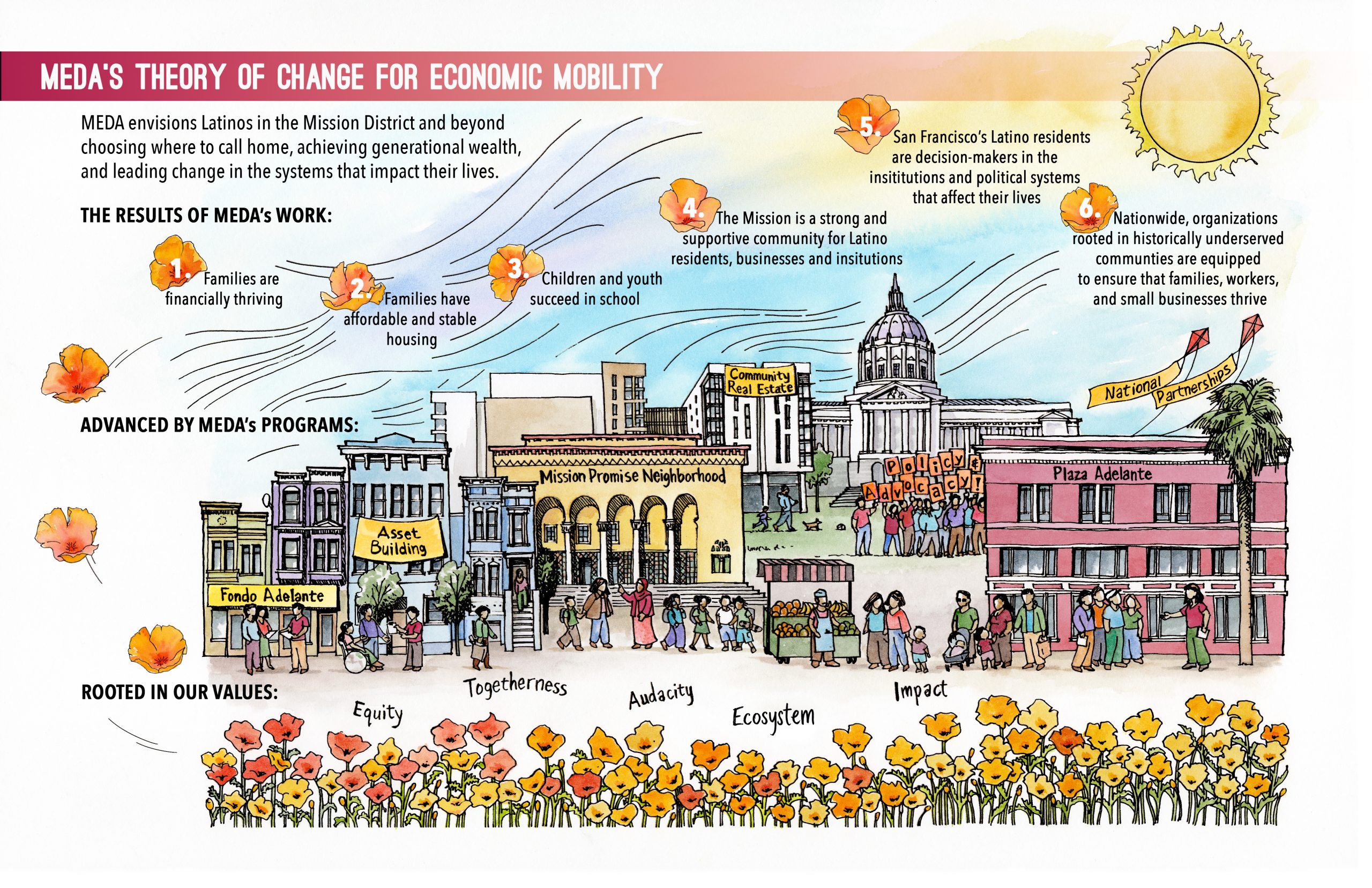
Click image to enlarge
By integrating direct services, policy advocacy, community ownership, and strategic partnerships, MEDA breaks systemic barriers and creates the conditions for Latinos to build wealth across generations.
Our Approach
MEDA’s mission to advance economic mobility and vision of Latino communities building generational wealth and leading the systems that shape their lives are grounded in our values of equity, audacity, ecosystem, impact, and togetherness. Our Theory of Change translates this foundation into action through four strategic priorities for 2025-2030: Building Pathways to Economic Success, Anchoring Community through Housing & Cultural Placekeeping, Scaling Cradle-to-Career Opportunities, and Advancing Systems Change and Community Power. Together, these priorities drive toward six key results: financial security, stable housing, educational success, cultural vitality, political power, and movement-building.
Mission, Vision, Values & Results >
Mission
Rooted in San Francisco’s Mission District, MEDA works in partnership to advance economic mobility for Latino communities by fostering community ownership, pathways to opportunity, and lasting systems change.
Vision
MEDA envisions Latinos in San Francisco’s Mission District and beyond choosing where to call home, achieving generational wealth, and leading change in the systems that impact their lives.
Core Values
Equity – Togetherness – Audacity – Ecosystem – Impact
MEDA’s 6 Key Results
Our work is focused on achieving six key results that will transform the lives of Latino families and strengthen communities across San Francisco and beyond.
- Result 1: Families are financially thriving
Latino families achieve long-term financial security and build generational wealth. - Result 2: Families have affordable and stable housing
Latino families can afford to live in safe, quality housing within their communities. - Result 3: Children and youth succeed in school
Latino children and youth have the support they need to excel academically and develop their potential. - Result 4: The Mission is a strong and supportive community for Latino residents, businesses and institutions
The Mission District remains a vibrant cultural hub where Latino families, businesses, and organizations thrive - Result 5: San Francisco’s Latino residents are decision-makers in the institutions and political systems that affect their lives
Latino residents have the power and representation to shape policies and institutions that impact their communities. - Result 6: Nationwide, organizations rooted in historically underserved communities are equipped to ensure that families, workers, and small businesses thrive
Community-based organizations across the country have the capacity and resources to advance economic mobility in their communities.
Four Strategic Priorities
Our approach to advancing economic mobility from 2025 to 2030
Economic mobility: Refers to a person’s or family’s ability to improve their economic situation over time, often across generations. It includes changes in income, wealth, educational attainment, housing stability, and civic power.
Expanding Access to Opportunities for Economic Mobility: A network of neighborhood services that supports families and individuals, meeting them where they are to support clients in goal setting, and expand their ability to access opportunities for economic mobility.
Creating an Ecosystem of Opportunity: A place-based approach focuses on creating an ecosystem of opportunities by building neighborhood assets – affordable housing units, community development financial institutions, cradle-to-career pathways, and intentionally strengthening community power to affect systems change in the Mission District.
Focus Area 1: Build Pathways to Economic Success
Provide families and entrepreneurs with the integrated tools, resources, and capital they need to achieve economic mobility.
MEDA advances economic mobility through an integrated approach that aligns coaching, workforce development, entrepreneurship, small business lending, and asset building. When families and entrepreneurs can meet immediate needs, manage expenses, build assets, and plan for the future, they have the freedom to make choices that improve their lives. By connecting clients to opportunity while building long-term financial health, MEDA ensures Latino communities can achieve economic mobility and accumulate wealth that endures across generations.
Community Voices
I didn’t know the first thing about how to open a business… they coach, they mentor, they go step by step.— Client
Selected Goals & Metrics (2025-2030) | Previous
GOAL 1.1: Increase Family Financial Health
3,000 financial coaching clients improve at least one DISC outcome within 6 months of engagement (500 clients annually).
GOAL 1.2: Accelerate Entrepreneurial Success and Business Sustainability
Deploy $10,000,000 in low-cost lending capital ($2,000,000 annually). Assist 2,000 emerging entrepreneurs with technical assistance, sustainability and business growth (400 entrepreneurs annually).
GOAL 1.3: Expand Access to Living-Wage Career Pathways
450 workforce participants will earn an industry-recognized certification (90 annually). 35 new businesses launched (7 annually), 400 businesses retained (80 annually) as a result of our $3,625,000 in lending and business development programming ($725,000 annually).
GOAL 1.4. Integrate Economic Mobility Programming in All of MEDA’s Direct Services.
Formalize youth-focused financial capability coaching and workforce development programming as key components of generational wealth building as a multi-generational approach.

Focus Area 2: Anchor Community through Housing Cultural Placekeeping
Ensuring Latino families, entrepreneurs, and community organizations stay rooted and thriving in the Mission District.
MEDA keeps families, small businesses, and nonprofits rooted in the Mission through quality, permanently affordable housing and commercial spaces, which we call cultural placekeeping. We approach housing as both a fundamental human right and a pathway to building community wealth, combining new construction and preservation of affordable homes with housing counseling, tenant advocacy, and policy leadership. By aligning real estate projects, financial empowerment programs, and public-sector partnerships, MEDA ensures that Mission residents, businesses, and institutions have affordable spaces and the resources to remain in and strengthen the community’s Latino culture.
Community Voices
Housing is fundamental—it is the equilibrium for yourself and your children. — Client
Selected Goals & Metrics (2025-2030) | Previous
GOAL 2.1: Expand Permanently Affordable Housing and Commercial Space
Develop, acquire, or preserve 500 (150 units in preservation and 350 units in production) additional units of affordable housing (100 units per year). Add 10,000 square feet of community-serving commercial space (2,000 sf per year).
GOAL 2.2: Prevent Displacement and Maintain Housing Stability
625 clients receive eviction prevention services (105 per year), including legal support, tenant counseling, and emergency stabilization, resulting in an estimated 500 achieving a positive outcome (100 per year). Place 550 clients in affordable Below-Market-Rate housing (110 per year). Keep 5,000 households stably housed in MEDA’s affordable housing (1,000 per year).
GOAL 2.3: Build Climate-Resilient Affordable Housing
Retrofit 19 buildings (4 buildings per year) of MEDA-owned properties to achieve All Electrification standards by 2030.
Focus Area 3: Scale Cradle-to-Career Opportunities
Support lifelong learning and career development from early childhood through professional advancement.
MEDA creates equitable pathways for Latino children and youth to excel in school, pursue higher education, and realize their aspirations. Educational opportunity is one of the most powerful drivers of economic mobility, and ensuring young people succeed is essential to breaking cycles of poverty and sustaining the Mission’s vitality for future generations.
Through the Mission Promise Neighborhood, MEDA serves as the backbone agency, aligning education, housing, and family supports so children can thrive from prenatal through career. Our new youth programs integrate our services tailored to San Francisco’s youth. Our holistic approach engages parents, schools, and community partners to remove barriers and expand opportunities, integrating early learning, after-school programs, and college access with economic resources for families to strengthen both academic and lifelong outcomes.
Community Voices
Educational opportunity is one of the most powerful drivers of economic mobility.— Client
Selected Goals & Metrics (2025-2030)
GOAL 3.1: Ensure Children and Youth Achieve Educational Milestones
Increase Kindergarten Readiness in MPN schools to 65% from 49% in 2025, decrease chronic absenteeism in MPN schools to 25% (pre-pandemic levels) from 41% in 2025, and increase high school graduation in MPN schools to 90% from 78% in 2025.
GOAL 3.2: Expand Family Holistic Support & Educational Engagement
We coach 1,052 families at MPN schools — 263 each year — connecting them to essential services and benefits that stabilize their finances and support their children’s academic success. Our Family Success Coaches guide families toward economic mobility and lasting generational wealth.
GOAL 3.3: Build Promise City, A Citywide Ecosystem of Family Success
Create the blueprint to expand Promise Neighborhoods to several additional neighborhoods, serving 20,000 children annually across San Francisco by 2030, aligned with the Mayor’s Family Opportunity Agenda.
Focus Area 4: Advance Systems Change and Community Power
Build community leadership and advocate for policy changes to make lasting mobility possible at scale.
MEDA amplifies Latino leadership by centering community voice and building civic power, locally and nationally. Through resident leadership development, data-informed advocacy, and coalition-building, MEDA ensures Latino residents have a seat at the table as well as shape the agenda. We also partner with community-based organizations nationwide, sharing tools and insights developed through decades of Mission-based work, because local victories create proven models that advance economic mobility at scale.
Community Voices
MEDA is always innovative, looking at what’s happening not just locally, but at the state and national level.— Community Partner
Selected Goals & Metrics (2025-2030)
GOAL 4.1: Win Policy Changes that Expand Opportunity
Influence 50 policies (10 annually) that support Latino businesses’ vitality, fund city, regional, and state packages for affordable housing and cradle to career programs, protect low-income tenants from displacement, and create equitable land use outcomes.
GOAL 4.2: Build Latino Civic Engagement and Political Power
Engage 750 community members (150 annually), with 250 emerging as trained leaders (50 annually), resulting in 1,250 civic actions (250 actions per year).
GOAL 4.3: Strengthen the National Economic Mobility Ecosystem
Scale MEDA’s place-based economic mobility frameworks nationwide by providing direct technical assistance and developing communities of practice for 300 peer organizations (60 per year). Establish MEDA as an industry leader and convener by co-leading and/or influencing 60 national coalitions (12 coalitions per year).
Building an Ecosystem of Opportunities in the Mission District

Focus Area 1: Building Pathways to Economic Success
Provide families and entrepreneurs with the integrated tools, resources, and capital they need to achieve economic mobility.
Focus Area 2: Anchoring Community through Housing Cultural Placekeeping
Ensure families, entrepreneurs, and community organizations can stay in their communities and maintain thriving cultural connections through affordable housing.
Focus Area 3: Scaling Cradle-to-Career Opportunities
Support lifelong learning and career development from early childhood through professional advancement.
Focus Area 4: Advancing Systems Change and Community Power
Build community leadership and advocate for policy changes to make lasting mobility possible at scale.
MEDA is developing a campaign to scale its successful Promise Neighborhood across San Francisco.
Promise City: A Deeper Dive
Mission Promise Neighborhood (MPN)
Mission Promise Neighborhood (MPN) is MEDA’s flagship program dedicated to increasing early learning enrichment, student academic achievement, family economic success, and affordable housing through trusted coaches co-located at schools, early learning centers and community hubs. Through MPN, MEDA brings together local nonprofits, public agencies, employers, and philanthropic organizations to put low-income children on a path to economic mobility by creating a coordinated continuum of solutions that support them from cradle to career.
MPN uses a two-generation approach, serving families at:
K-12 Schools
Early learning centers
Family child care providers
A National Model
The Promise Neighborhood initiative is a nationally recognized, federally funded, place-based model that increases economic mobility in low-income neighborhoods, building on the success of the Harlem Children’s Zone. There are 46 Promise Neighborhoods across the United States, including 6 in California.
“The Promise Neighborhoods model combines high-quality education with community and family-based support and provides continuous, two-generational services from cradle through college to career. Research demonstrates that young people are more likely to succeed in school when their comprehensive needs are met.”
Measurable Results
Kindergarten Readiness
Improved in 4 of 6 Promise Neighborhoods, including San Francisco. Strongly correlated to future academic success.
-14% Chronic Absenteeism
Decreased by 14 percentage points across 35 Promise Neighborhood schools. Attendance is critical to staying on track.
+9% High School Graduation:
Increased by 9 percentage points, opening doors to higher education and greater lifetime earning potential.
Comprehensive evaluation of the California Promise Neighborhood Network by RTI International (2012-2023)
Areas of Exploration
These seven areas chart MEDA’s path forward in economic mobility. Each builds on what works and moves us toward greater impact for the families and communities we serve. Together, they will expand our capacity and strengthen our ability to deliver transformative, scalable results alongside trusted partners.
1. Affordable Housing Financing Models:
The strategy focuses on establishing the mechanisms and infrastructure needed to deploy innovative real estate financing tools for both housing preservation and new construction. This includes developing financing models such as institutional impact investments to capitalize a rapid-acquisition fund, using tax-exempt 501(c)(3) bonds, leveraging tax-credit properties, and potentially employing sole-developer models. The goal is to create a diverse and flexible financial vehicle that supports affordable housing initiatives.
2 Innovative Small Business/CDFI Models:
A key priority is to enhance Fondo, MEDA’s Community Development Financial Institution (CDFI), to better serve small businesses by developing innovative lending and investment models. This involves diversifying Fondo’s financial product offerings beyond current loan offerings, and could include instruments such as grants and/or equity investments. Concurrently, we plan to explore creating a dedicated revolving small-business investment fund. Such a fund would establish a sustainable source of capital designed to support the growth and expansion of local enterprises, thereby fostering place-based economic development within the community.
3. Accessible Endowment:
This fund is designed to serve two critical purposes for MEDA. Firstly, it will act as a financial buffer, allowing the organization to manage and mitigate the impact of external revenue fluctuations. With a reserve, MEDA can ensure the consistent, stable delivery of its essential programs and services, preventing disruptions regardless of changes in the external funding environment. Secondly, the fund will provide the necessary agility to capitalize on unexpected strategic opportunities. Without such a reserve, valuable opportunities to expand reach, innovate programs, or invest in new initiatives may be missed due to an immediate resource shortage. In essence, the Rainy Day Fund secures both the stability of current operations and the potential for future growth.
4. National Training and Capacity Building:
Establish a robust community and economic development training program to build and scale the place-based, Latino economic development sector. This institute aims to significantly build professional capacity for individuals and strengthen organizational capacity for participating entities. A core function of the institute will be to create a dynamic learning exchange among participants, facilitating the sharing of successful strategies and best practices in place-based economic development. The ultimate goal is to equip participants with practical, applicable knowledge that can be effectively implemented in communities across the nation.
5. Climate Resilience & Environmental Stewardship:
MEDA recognizes the growing importance of environmental stewardship and climate resilience and is committed to making these priorities stronger. This commitment will be addressed through several avenues, starting with a focus on internal workplace practices, including monitoring current operations and implementing changes to reduce the organization’s environmental footprint. Externally, MEDA will leverage its programs to support small business clients in transitioning to more sustainable, “green” business models. Furthermore, the organization will ensure that all its affordable housing developments are built and maintained to meet rigorous climate resilience standards, protecting residents and properties from environmental impacts.
6. AI & Technology:
Leverage innovative technologies to streamline operations across the organization to provide more effective and far-reaching services, and optimize internal processes to reduce administrative overhead and ensure effective resource use. This includes supporting and deepening genuine community connections, rather than replacing them, and ensuring the responsible and secure use of technology, with a focus on safeguarding the private data of the individuals served.
7. Multi-Disciplinary Apprenticeship Academy:
Build a multi-disciplinary apprenticeship academy that rivals traditional degrees. This innovative model would blend workforce training with entrepreneurship programming tailored for immigrant workers, creating multiple pathways to economic mobility and career success. We aim to create clear and accelerated pathways to skilled careers, focusing on emerging or critical sectors. This will be achieved through hands-on learning, including the development of a multi-disciplinary apprenticeship academy. This model is designed to equip graduates with the skills necessary to compete for careers that have traditionally required a college degree. Strong, collaborative relationships with employers are essential to the success of this strategy.
Organizational Foundations
MEDA’s values of Equity, Audacity, Ecosystem, Impact, and Togetherness drive us to show up differently. Our values shape how we partner in our mission-aligned ecosystems, inform our culture that powers how we work, and hold us accountable to the communities we serve. Our values underpin the following three organizational foundations, which ensure MEDA has the internal strength to deliver transformative impact for San Francisco families.
1. Organizational Alignment & Integration
This foundation focuses on creating cohesive strategies and maximizing community impact by strengthening internal communications, program integration, and cross-departmental coordination. By expanding shared systems and investing in real-time connection, we aim to ensure clarity, reduce duplication, and accelerate progress toward our shared vision for economic mobility.
2. Talent & Organizational Culture
Our goal here is to attract, develop, and retain exceptional team members by building a strong organizational culture. Over the next five years, we will deepen our investment in staff development, leadership pipelines, and equitable management practices, including the implementation of clear growth pathways and structured mentorship. We will also codify expectations for well-being and flexibility, ensuring our systems reflect the diversity and strengths of our community.
3. Sustainability & Adaptive Capacity
This foundation ensures MEDA’s long-term viability through financial health, innovation, and responsive practices. We will invest in technology, systems, and talent to strengthen resilience and agility by diversifying funding streams, enhancing financial oversight, and expanding philanthropic partnerships. Adaptive learning and scenario planning will guide our decisions, ensuring we can rapidly respond to change and continue to deliver impact for decades to come.

Join Us in This Work
This strategic plan represents more than MEDA’s roadmap—it’s an invitation. We invite funders, partners, and allies to join us in realizing a future in which Latino and immigrant families have the genuine power to shape their lives and communities. The opportunities ahead are significant:
- Expanding proven programs that change lives at scale
- Testing innovative approaches that could transform the field
- Building partnerships that strengthen the ecosystem
- Demonstrating what’s possible when communities lead
Your partnership makes this vision achievable. Together, we can ensure that economic mobility becomes a promise we deliver for all families. Reach out to us at development@medasf.org